
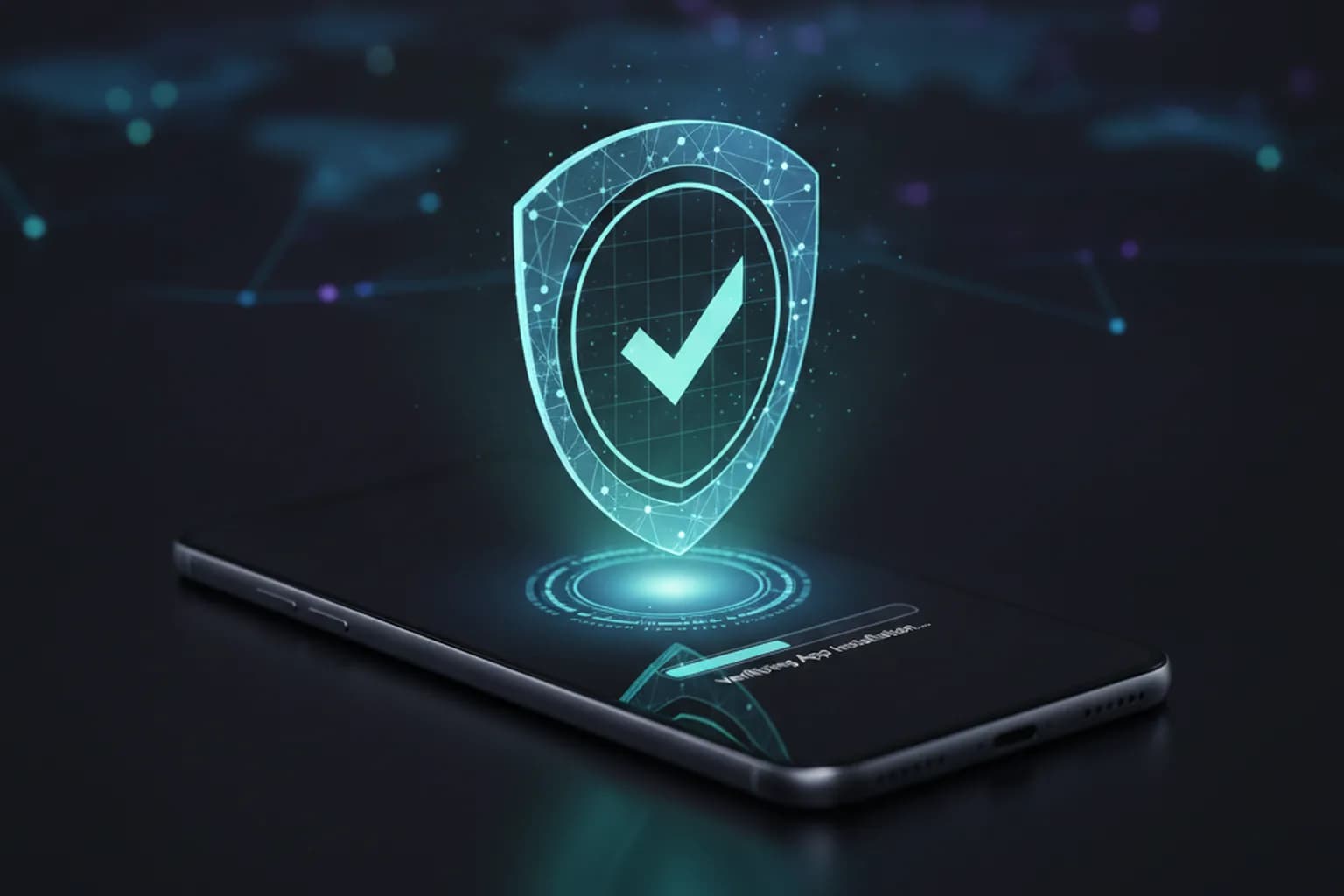
In short: Developer verification is a new Google requirement under which certified Android devices will only install apps from developers who have confirmed their identity. The rule covers not just Google Play but also third-party stores and manual APK installs (sideloading). A developer registers in the new Android Developer Console and provides a real name, address, phone and email. Key point: verification removes the author's anonymity, but it does not guarantee that the app itself is safe. Responsibility for what you install still rests with you.
What Android developer verification is
In August 2025 Google announced a mandatory developer identity check for every app installed on certified Android devices — that is, phones and tablets shipped with Google services (Google Play services). Previously only developers publishing on Google Play went through verification. Now the same requirement extends to apps from third-party stores and to APK files that a user downloads and installs by hand (sideloading).
The mechanism does not scan the app's code or judge what it actually does. It answers a different question — who wrote this program and can they be traced in the real world. The developer registers in the new Android Developer Console and confirms a legal name, address, email and phone number. After that, their apps are marked as coming from a verified developer.
For Google this is a way to strip anonymity out of the distribution chain. A large share of mobile fraud and banking trojans spreads precisely through APKs from anonymous "developers" who cannot later be held accountable. When every app has an identified author with confirmed contact details, distributing malware at scale becomes noticeably harder.
Who is affected and who is not
The requirement targets certified Android devices — those that ship with Google services and the Play Store. That is the vast majority of phones sold at ordinary retail. Here is how it looks for different scenarios.
- Install apps only from Google Play — you will notice nothing: the store already worked this way.
- Install APKs by hand or through third-party stores — you will see a difference: apps from verified authors install as usual, while unverified ones go through a harder path.
- A device without Google services (pure AOSP, some custom ROMs) is outside the requirement — but it also lacks built-in Google Play Protect.
- Advanced users keep the option to install via the ADB developer tool.
In other words, Google is not shutting sideloading down entirely. The goal is not to ban third-party installs but to ensure a specific, identified person or company stands behind every installer file.
What this means beyond Google Play
Regulatory pressure is pushing the mobile world toward more app stores, not fewer: in the European Union the Digital Markets Act has forced the big platforms to open up to alternative marketplaces and easier sideloading. Google's verification requirement runs alongside that shift. More sources of apps become available, but on certified Android devices each of those sources is still expected to carry apps from identified developers.
For a user the takeaway is the same regardless of which store you use: an alternative marketplace such as Amazon Appstore or an independent catalogue distributes apps just like any other channel, and the identity check applies to those installers too. Openness at the platform level does not remove your own responsibility to check where a file actually came from. The genuine security lever is the authenticity of the source, not the presence or absence of a badge next to the author's name.
When the new rules take effect: timeline
Google is rolling the change out in stages rather than all at once. Below are the key dates the company has officially announced.
- October 2025 — early verification access for the first developers.
- 30 March 2026 — verification opens to all developers through the new Android Developer Console and the existing Play Console.
- August 2026 — the advanced install path for apps from unverified authors and free limited-distribution accounts launch globally.
- 30 September 2026 — the requirement begins for users in Brazil, Indonesia, Singapore and Thailand (the first countries).
- 2027 — the requirement is planned to expand to certified devices worldwide.
The advanced flow for apps from unverified developers adds extra steps to installation plus a mandatory waiting period — on the order of a day before the app can run. This is deliberate: the friction should hinder mass malware campaigns while still leaving a technical path for people who know what they are doing.
What changes when you install apps
The easiest way to weigh the change is through risk: where the installer came from and what exactly is verified about that source. Identity checks raise the bar but do not remove the need for basic caution.
| Install source | What is verified | Residual risk |
|---|---|---|
| Google Play | Developer identity + Play Protect auto-scanning | Lowest, but not zero: some malware occasionally passes review |
| Third-party store with verified authors | Developer identity | Medium: the code itself is not guaranteed |
| APK from a verified developer, installed manually | Developer identity | Medium: the file must come from a genuine source |
| APK from an unverified author | Nothing; install only via the harder path with a delay | High: anonymous source, maximum caution needed |
The core takeaway is one thing: verification changes who is accountable for an app, not what is inside it. So the source you get the file from remains your main point of control.
How to tell an app is from a verified developer
In practice you will not check registries by hand. The system shows the difference at install time: an app from a verified author installs the usual way, while an unverified one comes with warnings and a harder path with a wait. A few pointers that help before you even install:
- Download installer files only from the developer's official site or their confirmed store profile — not from a link in a messenger or an ad.
- Match the developer name against what the product's official site says: fakes often differ by an extra character or a different domain.
- Be wary if you are pushed to install outside the store "right now" and rushed — legitimate products do not demand haste.
- Check which permissions the app requests on first launch: even an app from a real author may ask for too much. More on this in our guide to dangerous app permissions.
What verification does NOT guarantee
This is the section most often missed in the news. Developer verification is an identity check, not a security audit. The difference is fundamental.
A verified account only means Google knows the author's contact details and can block them and hand over data in case of abuse. The app's code itself is not read line by line. A verified developer can still ship an app with a vulnerability, excessive data collection or hidden ad payloads. On top of that, attackers can register accounts using stolen or shell identities, and honest accounts can be hijacked.
The practical conclusion: do not lower your guard because of a "verified developer" badge. The signs that something is wrong with a device — sudden battery drain, unfamiliar apps, pop-up ads — remain valid after 2026 too. If you notice any of them, cross-check the symptoms in our article on how to tell your phone has been hacked and do not ignore odd system behaviour.
Does a VPN protect against dangerous apps
It is important to separate two distinct layers of protection here, because they are often confused. A VPN works at the network level: it encrypts your internet traffic, hides your real IP address and keeps your provider or a public Wi-Fi owner from seeing which sites you reach. Developer verification and antivirus work at the app level: they deal with what program is installed and who wrote it.
That yields an honest answer: a VPN will not scan or block a malicious app you already installed yourself — that is not its job. But a VPN does close an adjacent class of risk tied to installation. When you download an installer over open Wi-Fi in a cafe or airport, the encrypted connection stops a man-in-the-middle attack from swapping the file or redirecting you to a phishing copy of the site. That is why safe installation and network protection are adjacent, complementary layers, not substitutes.
The sensible approach is to combine both: install apps from verified sources and keep your network traffic protected, especially on a phone that constantly joins other people's networks. If you use Android, a convenient start is setting up a VPN for Android — it covers the network layer while verification and Play Protect cover the app layer. Separately, remember that the VPN itself should be installed carefully: how to tell an honest service from a harmful one is covered in our piece on malicious VPN apps.
Checklist: how to install apps safely in 2026
A short list of actions that stays useful regardless of which country and exactly when the new rules take effect.
- Where possible, install apps from the official store — there identity checks are paired with Play Protect auto-scanning.
- If you install an APK by hand, take the file only from the developer's official site, not from a link in an ad, email or chat — how to do this right is described in our guide on how to download a VPN safely.
- Do not disable system warnings or rush through the advanced install path — the delay exists for a reason.
- When downloading installer files on public Wi-Fi, keep a VPN on to rule out file tampering on the network.
- After installing, review the requested permissions and revoke anything unnecessary.
- Keep Google Play Protect enabled — verification does not replace it.
- Once a month, review your installed apps and remove anything you do not use or do not remember installing.
- Keep the system and apps updated — fresh versions close known vulnerabilities.
Frequently asked questions
Does developer verification cost money for an ordinary user?
No. For anyone who just installs and runs apps it is free and mostly invisible. The developer pays and registers: a standard account costs around 25 dollars, and for students and hobbyists there is a free limited-distribution account for a small number of devices.
Will I still be able to install APK files after 2026?
Yes. Google is not banning sideloading entirely. Apps from verified authors will install as before, while unverified ones go through a harder path with a delay. For technical users, installation via the ADB developer tool remains.
If an app is from a verified developer, is it definitely virus-free?
No, verification gives no such guarantee. It confirms the author's identity but does not read the code line by line. A verified developer can ship an app with a vulnerability or excessive data collection, and an account can turn out to be hijacked. Caution is needed either way.
Do I need a developer account if I just use my phone?
No. Registration in the Android Developer Console is only for those who publish apps. An ordinary user does not need to register or confirm anything.
Does verification replace antivirus and Play Protect?
No, these are different layers of protection. Verification answers who wrote the app, while antivirus and Play Protect answer what the app does and whether it contains malicious code. They should be used together.
How does this relate to a VPN — is it no longer needed?
A VPN solves a different task and is still needed. Verification concerns the apps on your device, while a VPN protects network traffic: it encrypts the connection and hides your IP from your provider and public-network owners. One layer does not cancel the other.